The Anatomy of a Paradox: Octave Jumps, Nuance, and Emergence
The Anatomy of a Paradox: Octave Jumps, the emergence of nuance and an ancient kind of triangulation.
I've been thinking about spilling the beans on the anatomy of a paradox. Is that something you'd be into reading about?
I am not strictly speaking about the agreed-upon definition of a paradox per se, but the underlying information topology. What we'll discuss applies to the widespread definition as well—it's just perhaps not the most insightful possible kind of application.
First, let's see what Sapiens means by the word paradox at the moment in history:
- A statement contrary to common belief or expectation (from 14th-century French paradoxe).
- A logically self-contradictory statement.
- A train of reasoning that leads from premises that seem obviously true, via apparently impeccable steps of reasoning, to a conclusion that is contradictory or crazy.
But the expression that comes closest to the perspective I'd like us to explore, comes from Carl Jung:
"...only the paradox comes anywhere near to comprehending the fullness of life. Non-ambiguity and non-contradiction are one-sided and thus unsuited to express the incomprehensible".
To understand why this is, we need to pause looking at paradoxes as errors in our reasoning [1] , and consider looking at them as structural features of reality.
Some applied examples:
The Ship of Theseus: If you replace every single wooden plank of a ship over time, is it still the same ship? If those old planks are used to build another ship, which one is the "original"?
Birthday Paradox: In a room of just 23 people, there is a 50% chance that two of them share the same birthday. Our intuition expects a much larger group, but the number of possible pairs of people grows very quickly.
Schrödinger’s Cat: In a sealed box, a cat is linked to a quantum event that has a 50% chance of occurring. According to quantum mechanics, until the box is opened, the cat exists in a "superposition" of being both alive and dead at the same time. This highlights the measurement problem: when exactly does a quantum possibility become a physical reality?
Fermi Paradox: With billions of stars and planets in the galaxy, many of which are much older than Earth, why haven't we seen any signs of extraterrestrial civilizations? Solutions range from the "Great Filter" (life always destroys itself) to the "Zoo Hypothesis" (they are watching us without interfering).
Now let's go over what's actually happening in each of these examples.
- The ship of Theseus - here we are confusing the material makeup of the ship with its information content. It's a widely known factoid that the human body recycles all its cells every 7-10 years . While that's not exactly correct [2], we don't change names every 7 birthdays, so why should Theseus' ship?
- Birthday Paradox - here we are confusing the number of individuals and the number of connections [3]. In this case the math isn't interested in the people themselves; it is interested in the relationships (vertices) between them. When we switch from linear counting to combinatorics, the information density shifts and the low number of
nodesexplodes into 253 possiblepairs.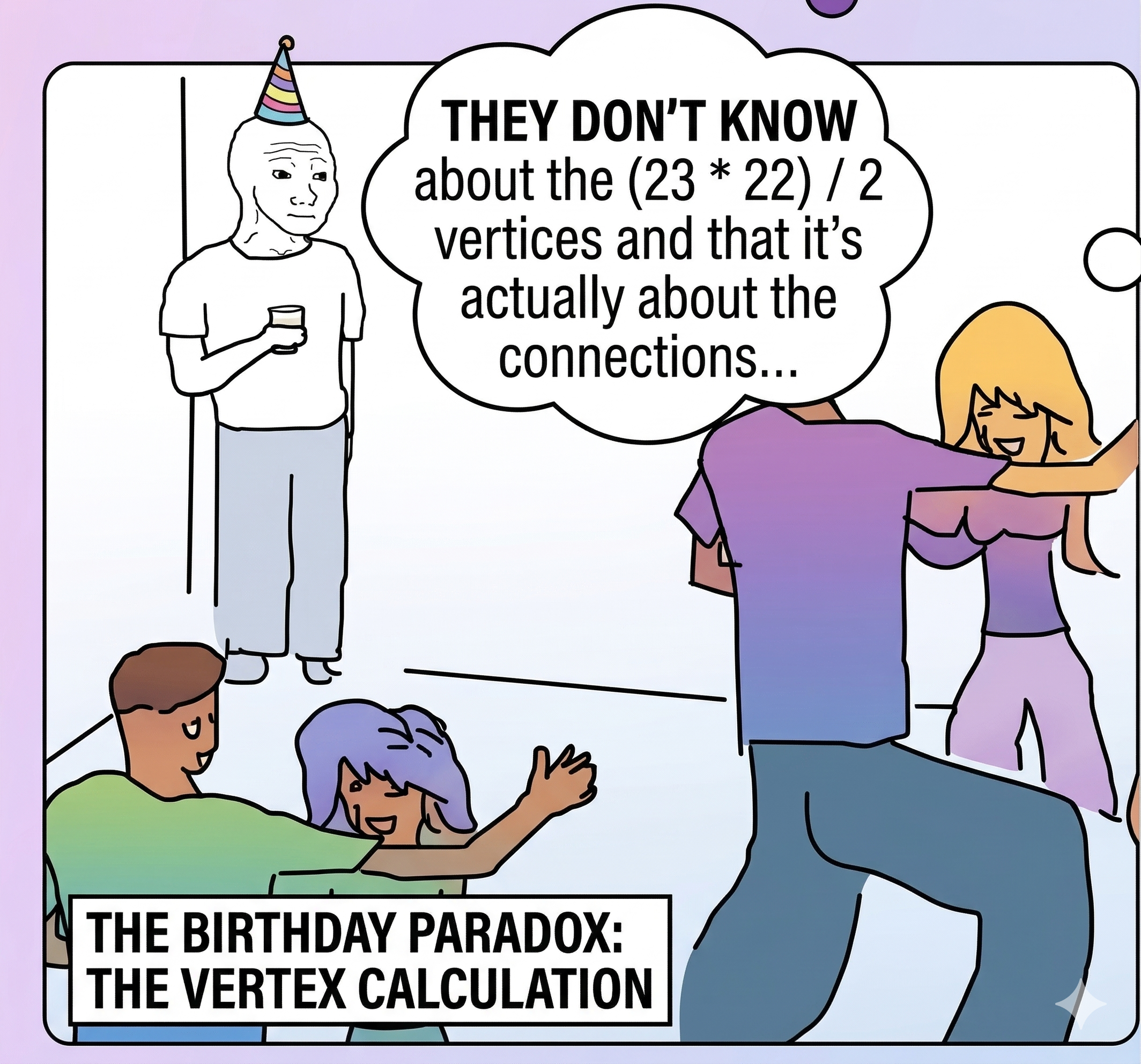
- Schrödinger’s Cat – arguably one of the most famous "paradoxes" during our time. If we look closely at what is happening here, we see the same pattern as before. Prior to the opening of the box, the quantum event exists in the "higher octave" (integrated superposition). The paradox isn't that the cat is magically two things at once; it's that our macro-level logic forces a localized "1/2 split" (Alive vs. Dead) onto a system that is operating at a 1/1 un-cleaved state (containing the full volume of possibilities). Opening the box is the dimensional bottleneck that forces us to let go of the more voluminous reality and choose one of its lower dimensional "shadows" -
aliveordead. - As for the Fermi Paradox... I'd suggest that this isn’t actually a paradox at all, but rather us trying to arrive at broad conclusions based on data that is severely lacking.
We can see that the word "paradox" is often used quite loosely and can sometimes indicate the peculiar topology that we've been discussing while other times it's close in meaning to something like "damned if I know" or "beats me". Sometimes Sapiens just use the word "paradox" when we mean "mystery".
For the purposes of this article though, a more formal definition for a "paradox" can be something as simple as "a transition point between a lower and a higher octave portion of an idea. For example, think of a piano. If you play a Middle C and then a High C, your ear recognizes a strange phenomenon. They are mathematically distinct frequencies (differentiation), yet they possess the exact same tonal essence (integration). They are undeniably different, yet undeniably the same. In music, we call this an octave. In logic, when we experience two ideas that are undeniably different yet intrinsically the same essence, we call it a paradox. We are just sensing the transition point between a lower and higher resolution of the same truth.
This happens because ideas traverse a bigger portion of multidimensional space than is widely documented, they are non-homogeneous in base topology. (Think of it like a cylinder: from the top it looks like a circle, but from the side it looks like a square. The shape changes depending on the dimension you view it from.)
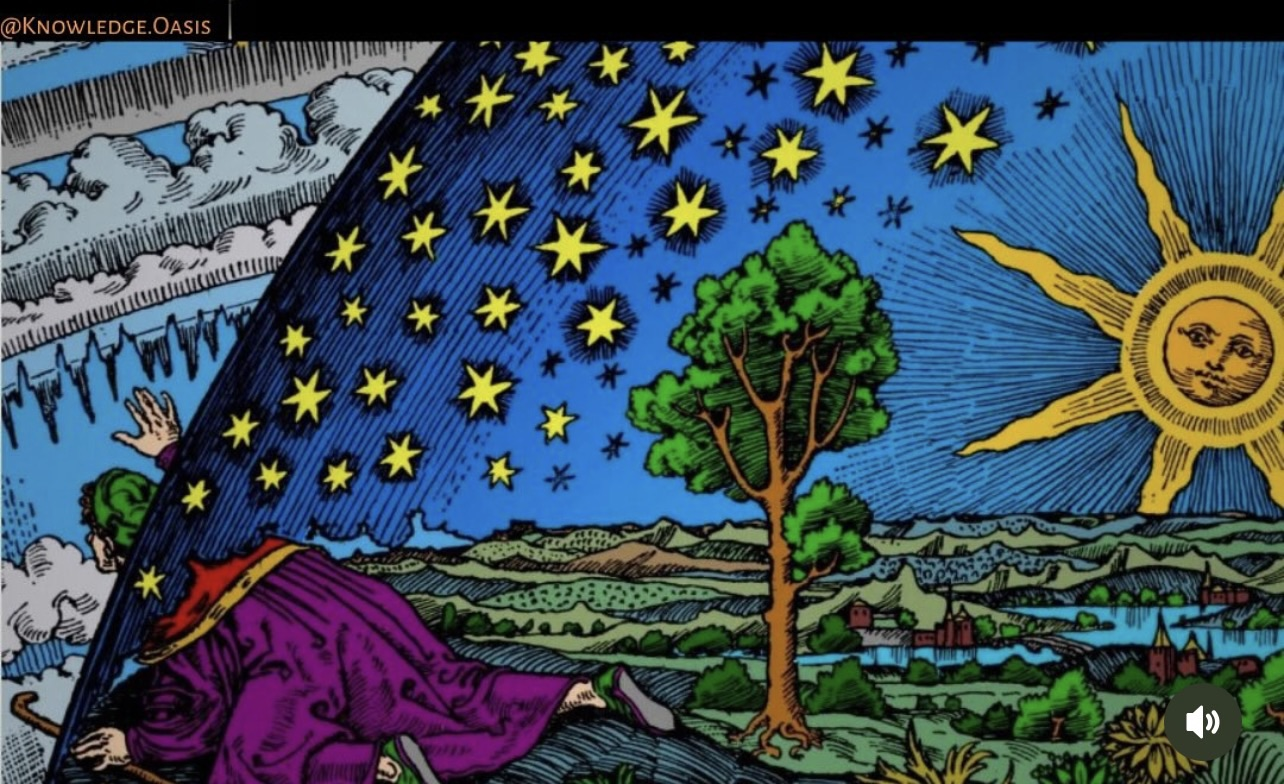
There is differentiation (a halving*) if you go in one direction, and integration (a merging) if you go in the other.
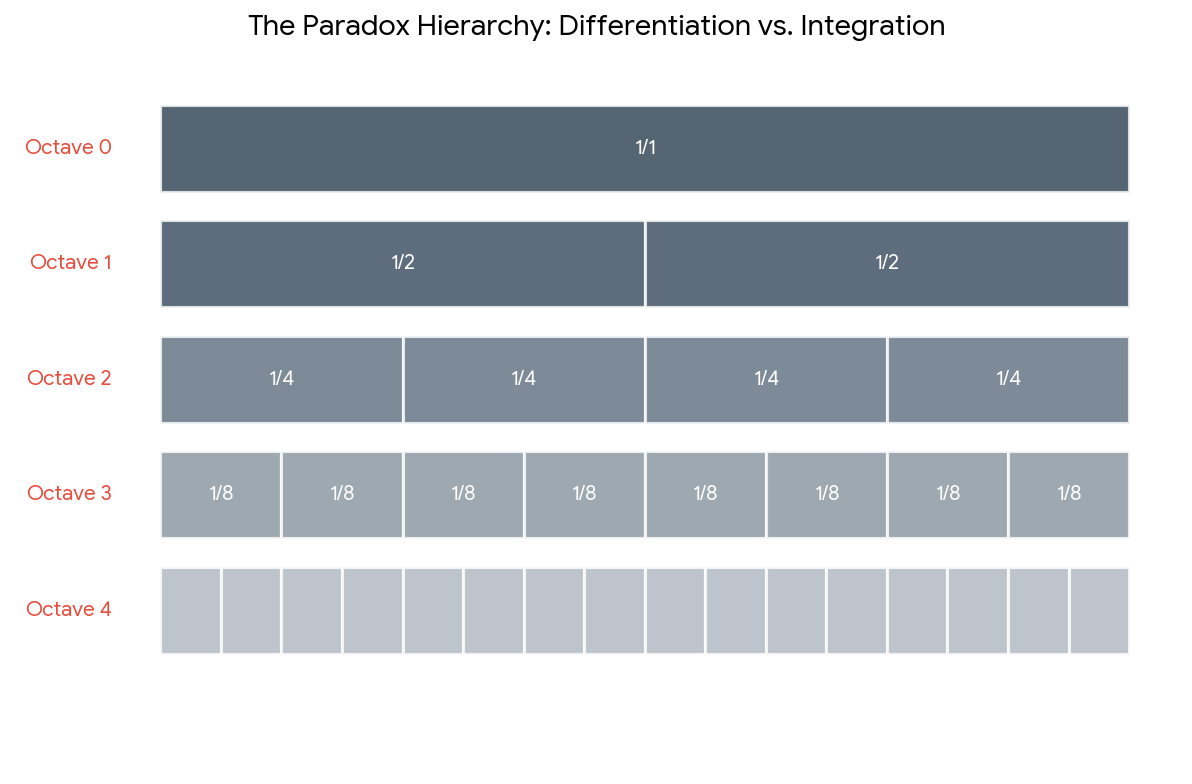
"Nuance" is one way in which we often describe the type of cognition that is able to navigate that transition point, a kind of sorting like with like that's not being carried away by what appears at a lower resolution.
"Integrative complexity" is the more formal way of referring to the recognition of the quality that things have where they are subject to differentiation at the same time as being subject to integration.
What makes this interesting to explore? IMO a few things, not the least of which includes the intersection between conflict resolution, higher dimensional geometry, and an applied dynamic interpretation of the yin/yang symbol (the depth of which has incidentally been hidden by 2d drawings).
Most human conflict is fundamentally a dimensional bottleneck. Imagine a 3D cylinder. If you shine a light on it from the side, it casts a 2D shadow of a square. If you shine a light from the top, it casts a 2D shadow of a circle. When two people fight—in politics, relationships, or philosophy—Person A is yelling "It's a square!" and Person B is yelling "It's a circle!" They are both factually correct at their lower resolution (n/8). "Nuance" isn't about compromising and calling it a squircle; it's about increasing the information density of the conversation until both parties can look up, see the 3D cylinder, and realize they were arguing over shadows of the same object.
Once we consider the characteristic of things changing quality as a function of quantity (think phenomena and behaviour emerging from scale), we can also answer the question "the whole is greater than the sum of the parts—but how and why?"
If you take a pocket watch and smash it with a hammer, you still have the exact same "sum of the parts." Every gear, screw, and glass shard is still on the table. But the "whole" is gone. Why? Because the "whole" didn't live in the brass; it lived in the invisible relationships between the brass. The geometry of how they connected contained a higher information density than the materials themselves. When we jump an octave (from parts to the whole) we aren't adding more material; we are adding the invisible architecture of relationships.
Hit the contact icon to let me know if you'd like to read more about information density - it's something I am considering writing about more extensively.
Although there are errors of different kinds (taxonomical errors, misconceptions about base facts, incorrect assumptions etc) in the historical mix as well ↩︎
which is actually not totally correct - some cells remain for much longer and in several cases, remain for life. Before you envision them as these static elements though, consider that the atoms that make those cells up continuously change. ↩︎
or to put it in computer science terms, we are confusing the number of nodes and the number of vertices. ↩︎